
Overview
Get to Know Harry and Lloyd!
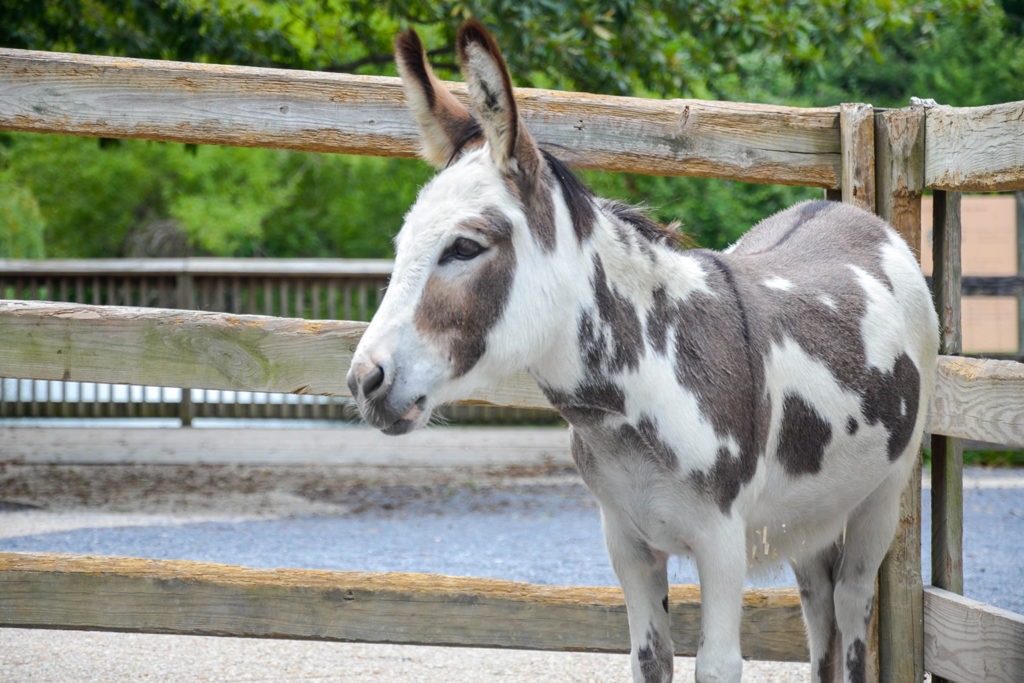
Brothers Harry and Lloyd were born in 2005 and have lived at the Maryland Zoo for most of their lives. Miniature donkeys are known to be gentle, intelligent, and sociable. Because of these traits, miniature donkeys often live with people as companion animals. This breed developed from two other breeds of miniature donkeys on the islands of Sicily and Sardinia. People used the original breed to haul carts or carry small loads.
On a visit to the Zoo’s Farmyard, you are likely to find the donkeys enjoying puzzle feeders. Much like puzzle feeders for pets, puzzle feeders at the Zoo slow an animal’s eating to a healthy rate. They also give the animals opportunities to solve problems, which is great for their mental wellbeing. And when they aren’t feeling hungry at the moment, they can come back to enjoy their puzzle feeders later.
Though both Harry and Lloyd enjoy interactions with their keepers, Lloyd is more likely than his brother to initiate an interaction with the care team. Harry prefers to focus his attention on chew logs, from which he diligently tears off the back. While Lloyd prefers interacting with items he can toss around the yard, Harry often picks up any enrichment items made of rubber and chases Lloyd with them!
Conservation Status
Miniature donkeys are a domestic breed, which means that they live closely alongside people. Because they are a domestic breed, they do not have an official conservation status.
Taxonomy
- Kingdom: Animalia
- Phylum: Chordata
- Subphylum: Vertebrata
- Class: Mammalia
- Genus: Equus
- Species: E. asinus asinus
Physical Description
There are approximately 10,000 of these donkeys in the U.S. today. They have been bred carefully over many generations for size, disposition, and conformation to certain bodily traits. Size is the defining breed trait. An adult miniature donkey cannot measure more than 36 inches tall, measured from the highest point of the withers. An exceptionally small animal could measure only 26 inches tall, but the average height is 33-34 inches.
Origins
The original two breeds from which miniature donkeys are descended are both native to Mediterranean islands. One is native to Sicily and the other to Sardinia, but the two breeds are genetically indistinguishable.
Introduction to North America
Miniature donkeys from Sicily and Sardinia were first imported into the United States in the early 1900s. These animals and their descendants were extensively bred with each other and with breeds of unknown ancestry to produce a distinctively American breed.
Uses
Miniature donkeys can serve as pack animals but are more often kept as companion animals. Because of their size and disposition, they are more easily handled than other breeds of donkey. They are known to be gentle, intelligent, and sociable. The miniature donkeys from which they are descended were bred as pack animals for hauling carts and carrying small loads.