

Overview
Get to Know the Goat Herd!
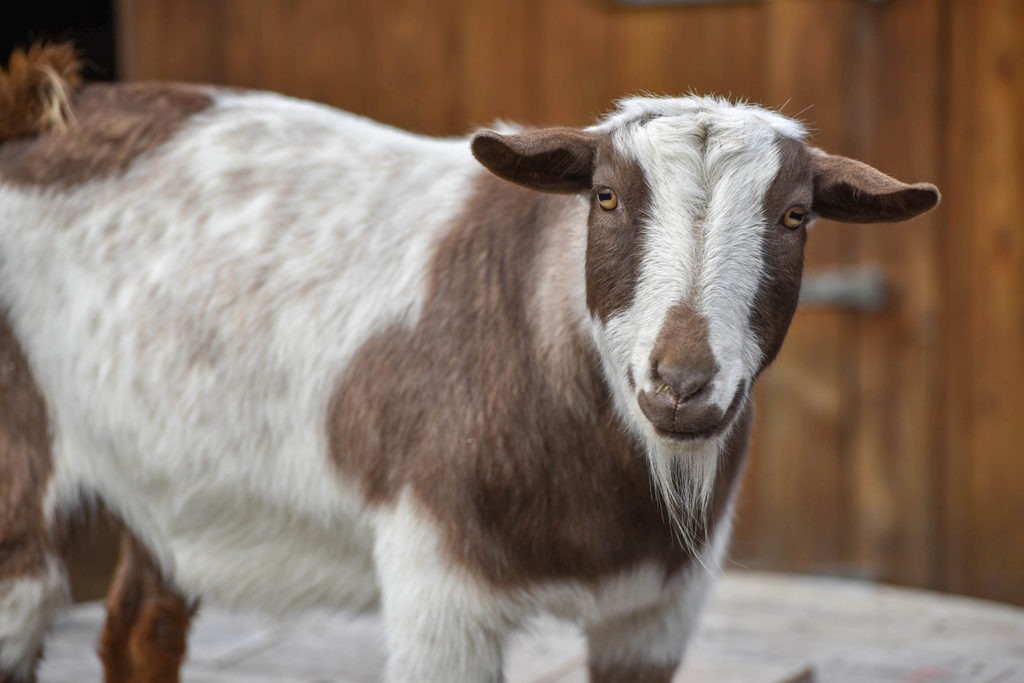
Nigerian dwarf goats are a colorful breed! With their different coat colors and patterns, the herd members can be fairly easy to tell apart. The newest members of the Zoo’s Nigerian goat herd are siblings, who were all born at Nashville Zoo: Sally in 2023 and her brothers Lightning and Mater in 2024. Sally’s coat is tan and white, and she has horns. Mater’s coat is black and tan while the coat of his twin brother Lightning is white, tan, and black. Lightning also has a touch of pink on his nose.
The Farmyard care team gives the goats plenty of items they can safely headbutt–a great way for goats to use this natural behavior! The main reason goats headbutt is to establish dominance in the herd. For younger goats in particular, headbutting can also be a form of play. Strong neck muscles and a thick skull make them well adapted for this behavior.
Conservation Status
Nigerian dwarf goats are a domestic breed, which means that they live closely alongside people. Because they are a domestic breed, they do not have an official conservation status.
Taxonomy
- Kingdom: Animalia
- Phylum: Chordata
- Subphylum: Vertebrata
- Class: Mammalia
- Order: Therapsid
- Family: Bovidae
- Genus: Capra
- Species: C. aegagrus hircus
Physical Description
The Nigerian dwarf goat is a miniature dairy goat of West African origin. They are similar in appearance to larger dairy goats but ideally, the does stand no taller than 17 to 19 inches and the bucks stand no taller than 19 to 20 inches. The coat can vary considerably by color and pattern. Ideal weight is about 75 pounds.
Origins
Now a domesticated breed, Nigerian dwarf goats are popular in the United States and many other parts of the world. The breed’s origins trace back to West African Dwarf (WAD) goats, which are prevalent throughout tropical western Africa. Most families in rural African villages keep at least a few goats for milk and meat.
Introduction to North America
Nigerian dwarf goats first entered the United States from West Africa in the early 20thcentury. See them at the Maryland Zoo in the Goat Corral in the Maryland Wildernesssection.
Uses
Nigerian dwarf goats are raised as companion animals and for their milk, which is high in butterfat and sweet tasting.
This exhibit is sponsored by