

Overview
Get to Know Sandy and Cypress!
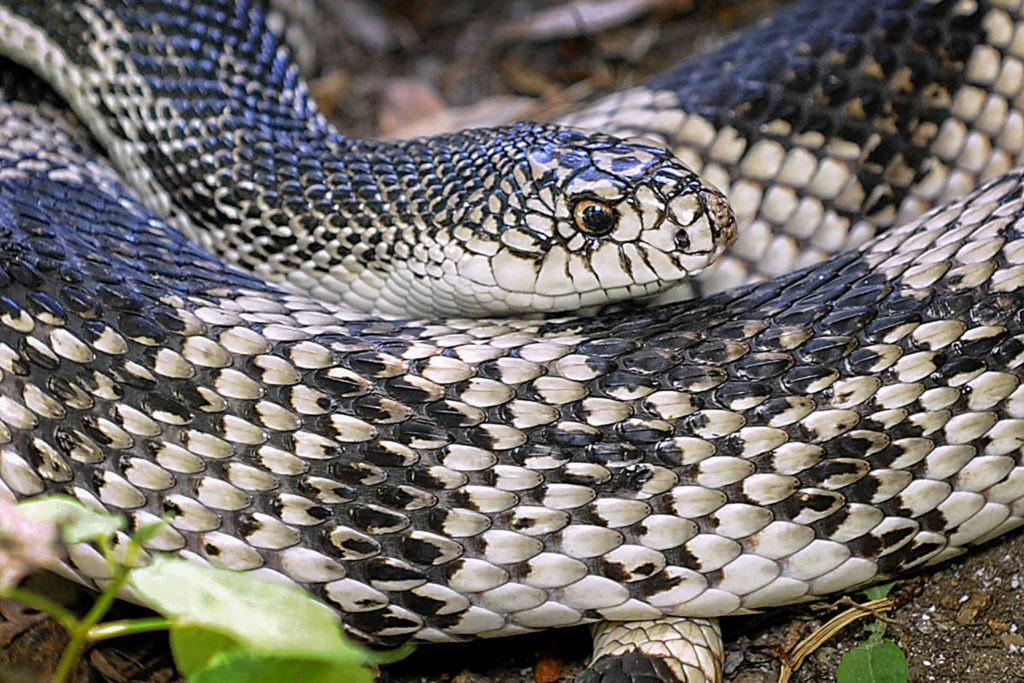
Northern pine snakes like Sandy and Cypress are a subspecies of Eastern pine snakes. This subspecies is known for their high-contrast black splotches along their bright white body. Sandy and Cypress are siblings who join us from the Toledo Zoo in Ohio.
Who’s Who
Zookeepers use the pine snakes’ subtle differences in overall color, black dot sizes, and black dot shapes to identify Sandy and Cypress. The most obvious spot difference between the two is the large, black letter C shape that Cypress has on the top left center of their head.
Where to Find Us
Both pine snakes typically utilize the entirety of their habitat, be it basking on a flat slab of wood, buried under the substrate on the ground, or resting in a high place. However, it can be a little surprising just how high the habitat space is. Both pine snakes sometimes rest on a light box that is only visible by looking high up when close to the glass. Look up and look carefully, and you might see two pine snake stomachs!
Special Care
Sandy and Cypress are fed at the same time, but they may take different amounts of time to bite down and finish eating their meal. In order to prevent one snake from finishing their food and then taking the other snake’s food before they can eat it, zookeepers will feed one of the snakes in a separate room. If you see a zookeeper entering the Northern pine snake habitat and leaving with one of the snakes in hand, there is a good chance that it’s feeding time! One of the snakes may also be moved out of the habitat for routine physical inspections.
Conservation Status
Least Concern
This status means that the population of Northern pine snakes living in their native habitat overall is doing well. However, on a state level, Northern pine snakes are listed as Endangered Extirpated in Maryland. This means that while this species was once known to live in Maryland, it has not been seen for a significant period and may no longer be found in this state. Northern pine snakes spend a significant amount of time burrowing underground, and so it may just be possible that they are just a very rare sight.
How you can help
All animals thrive when their habitats are in excellent condition. When you respect and care for local habitats, you’re helping these animals thrive. Keep habitats clean of trash and chemicals, stick to designated nature paths, and encourage the growth of native plants on land in your care.
Additionally, due to the rarity of Northern pine snakes in Maryland, if you ever spot a Northern pine snake out in their potential native range, you can help conservation researchers by reporting that you have seen one to your state’s wildlife agency (such as the Maryland DNR) or the U.S. Fish and Wildlife Service. Provide details on the location you saw them, even at a vague level. When you report a sighting, you help researchers understand that Northern pine snakes are present in specific ranges, sometimes even helping researchers discover new sites where these snakes live.
How the Zoo is helping
Many of the animals in the Maryland Zoo’s care that are native to Maryland are specifically native to Druid Hill Park, the park where the Zoo is located. The Maryland Zoo takes great care to ensure that zoo grounds benefit the wellbeing of all native animals found living within it. The Zoo prioritizes native plants, designs construction with wildlife safety in mind, and routinely surveys the grounds to check on the status of local populations.
Taxonomy
- Kingdom: Animalia
- Phylum: Chordata
- Subphylum: Vertebrata
- Class: Reptilia
- Order: Squamata
- Family: Colubridae
- Genus: Pituophis
- Species: P. melanoleucus melanoleucus