
Overview
Get to Know Oscarina and Wilson!
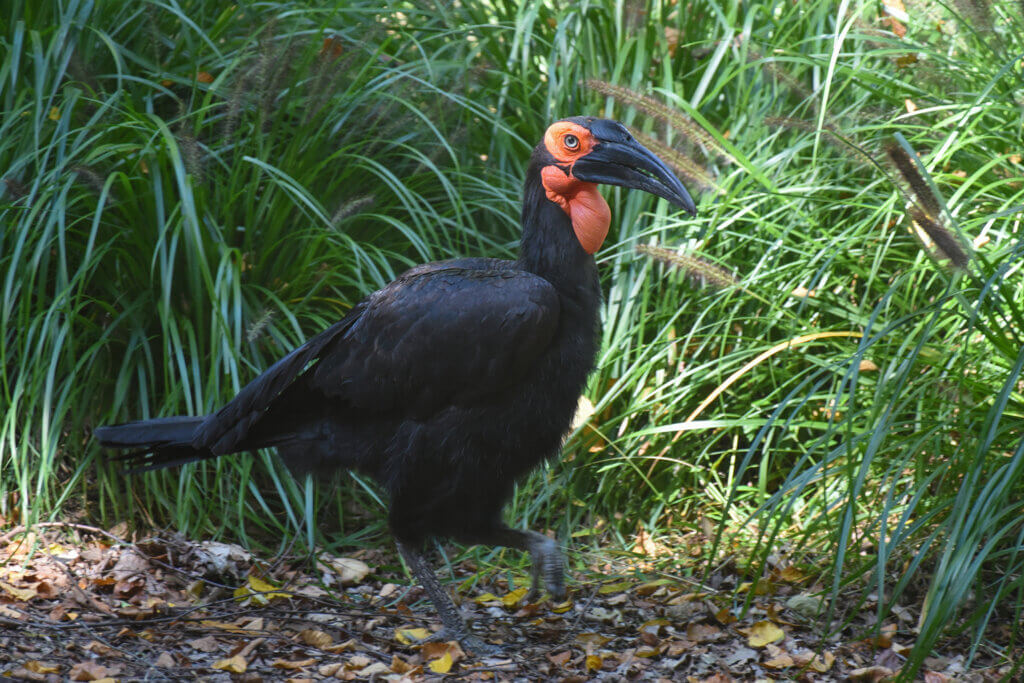
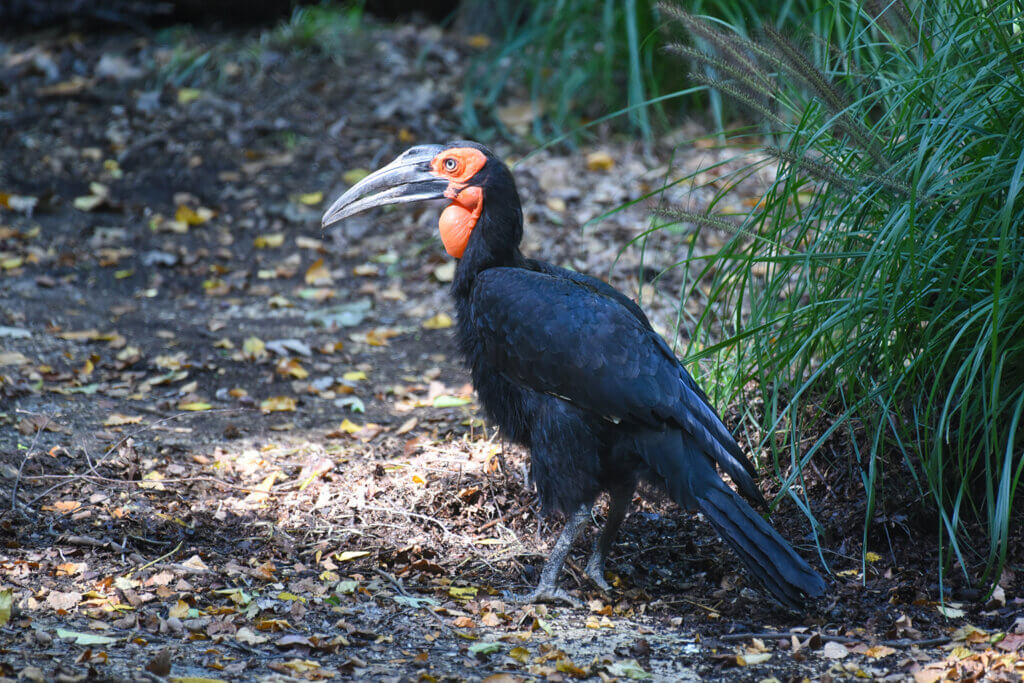
Southern ground hornbills like Oscarina (“Oscar”) and Wilson are one of the largest species of hornbill in the world. There are about 60 species of hornbill, and they are known for their long, down-curved beaks which are excellent for snatching small prey. Most hornbills, southern ground hornbills included, have a casque, an extension of the top of their beak that looks like a large bump. The casque helps amplify the booming four-note calls of the southern ground hornbill and acts as a shock absorber for any high-impact beak strikes. At the Zoo, you may see northern ground hornbills as well, and the shape of their casque is a great way to tell the two species apart–Northern ground hornbills have a larger casque with an opening in the front, while southern ground hornbill casques are a smoother bump.
Southern ground hornbills are carnivores and hunt for their prey in the long savanna grasses of southern Africa. They commonly walk in small groups to forage. They mostly pluck their prey from the ground, but will sometimes jump to reach prey in higher vegetation. After capturing a meal, they often toss the item into the air before catching and swallowing it. For larger prey, they hold the head in their bill and vigorously shake it to subdue the prey.
Who’s Who
Southern ground hornbills are sexually dimorphic, meaning that males and females have different physical features. The most obvious difference between males and females is the color of the bird’s puffy throat, or wattle. Oscarina, the female, has a violet-blue patch on her wattle, while Wilson, the male, has an all-red wattle.
Oscarina and Wilson can inflate their wattles to make their booming calls as loud as possible. At their loudest, these calls can be heard over one mile away and are sometimes mistaken for a lion’s roar! Both Oscarina and Wilson can participate in a behavior known as duetting–Wilson can make low-pitched calls while Oscarina responds with high-pitched calls. Duetting both advertises territory to other hornbills and strengthens the bond between the calling pair. Southern ground hornbills are monogamous and can stay in a pair for all of their lives, so a strong bond is crucial.
Where to Find Us
Wilson and Oscarina live in the top yard of the Wading Bird building, a habitat space between the Stone Barn and the Naturalist Lodge. Their yard was remodeled to tailor it for their needs, but the Wading Bird building itself has been around since 1959! Guests may remember that prior to this recent renovation, this yard once housed the Zoo’s Caribbean flamingos, who now live at the entrance of African Journey.
Although Wilson and Oscarina have lived at the Maryland Zoo since 2025, they are new to the Wading Bird yard. Over the next few months they will be getting to know their new homes, so they have yet to decide on their favorite spots in their zoo habitat. Check this page out in the near future to see updates about how the hornbills enjoy spending time in their space!
Conservation Status
Vulnerable
This status means that the population of southern ground hornbills in their native range is facing a high risk of extinction and requires ongoing conservation efforts. The hornbills face multiple threats. When humans convert savanna to agricultural land, the birds lose their nesting habitat. In some cases, southern ground hornbills are harmed directly by local people when the birds damage their property. And like most savanna-dwelling species, southern ground hornbills are losing quality habitat due to climate changes that worsen droughts. Drought conditions make it more difficult for the hornbills–or their prey–to find the food and water they need to survive. To help make a positive impact on climate for all grassland species– and all species on Earth, for that matter– consider getting involved in community projects that replace fossil fuels with clean energy sources like solar and wind.
Taxonomy
- Kingdom: Animalia
- Phylum: Chordata
- Subphylum: Vertebrata
- Class: Aves
- Order: Bucerotiformes
- Family: Bucorvidae
- Genus: Bucorvus
- Species: B. leadbeateri