

Overview
Get to Know the Northern Pintails!
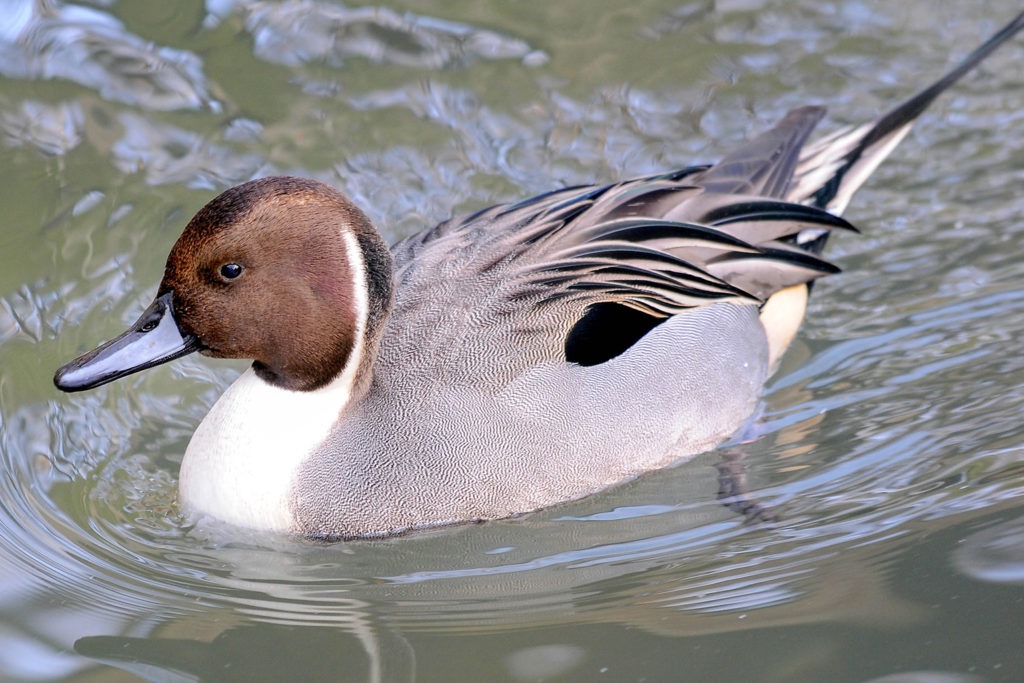
Northern pintails are best identified by their namesake: long, pointed feathers on their tails that look sharp, but are feather-soft. In the breeding season of April to June, males have a gray body with black feathers along their wings as well as a white neck and a brown head. Females have a more uniform spotty brown body. Males and females may look quite similar outside of the breeding season as the male develops a brown plumage as well.
Who’s Who
During the breeding season, the male and female pintail are best identified by their coloration, the male having gray plumage and the female having brown plumage. Guests can also tell them apart by the bands on their legs: the male has a band on his right leg and the female has a band on her left.
Where to Find Us
The male and female pintails are often close by each other and spend a majority of their time in the water in the center section of the Marsh Aviary, although they are on land in the grasses more often than the other ducks.
In the springtime, if guests only spot the male pintail, there is a chance that the female is close by in the grasses, sitting on an exceptionally well-hidden nest! Northern pintails nest farther from the water than most North American ducks, and they are not picky in their choices for nesting sites throughout the grasses in their habitat.
Special Care
At feeding time, the northern pintails are often the first to approach the zookeepers as they provide new food. If the keepers are scattering food into the water outside of their floating feeder (a feeding style known as broadcast feeding) they are quick to dabble near the keeper. Their long necks allow them to reach deeper parts of the aviary water than most other ducks, and they can spend up to six seconds with their heads tipped into the water searching for food.
The male and female northern pintails are well-paired in the Marsh Aviary, staying close year after year. Northern pintails are a seasonally monogamous species, with pairing choices made in flight! Multiple males may pursue a flying female, and the male best suited to keep up with the female is most likely the chosen mate for the season.
Conservation Status
Least Concern
This status means that the population of Northern pintails living in their native habitat is doing well, but there are always opportunities to ensure this species can thrive.
How you can help
All waterfowl need a safe, clean habitat where they can feed and nest. You can help local Maryland species of ducks, geese, and swans by keeping trash out of wetland habitats and waterways.
You can also support the wellbeing of waterfowl by refraining from giving them human food. Although feeding local wildlife can feel helpful, it can actually harm them. They may become more bold and aggressive. In addition, bread and other human foods are not healthy items for waterfowl.
How the Zoo is helping
The Maryland Zoo is one of many zoos that house animals that have been rehabilitated but can no longer survive without professional care. A bird may be unreleasable due to severe injuries that prohibit movement, a lack of fear of humans, or damage to their senses that makes it hard for them to find food or avoid predators.
Taxonomy
- Kingdom: Animalia
- Phylum: Chordata
- Subphylum: Vertebrata
- Class: Aves
- Order: Anseriformes
- Family: Anatidae
- Genus: Anas
- Species: A. acuta