

Overview
Get to Know the Hooded Mergansers!
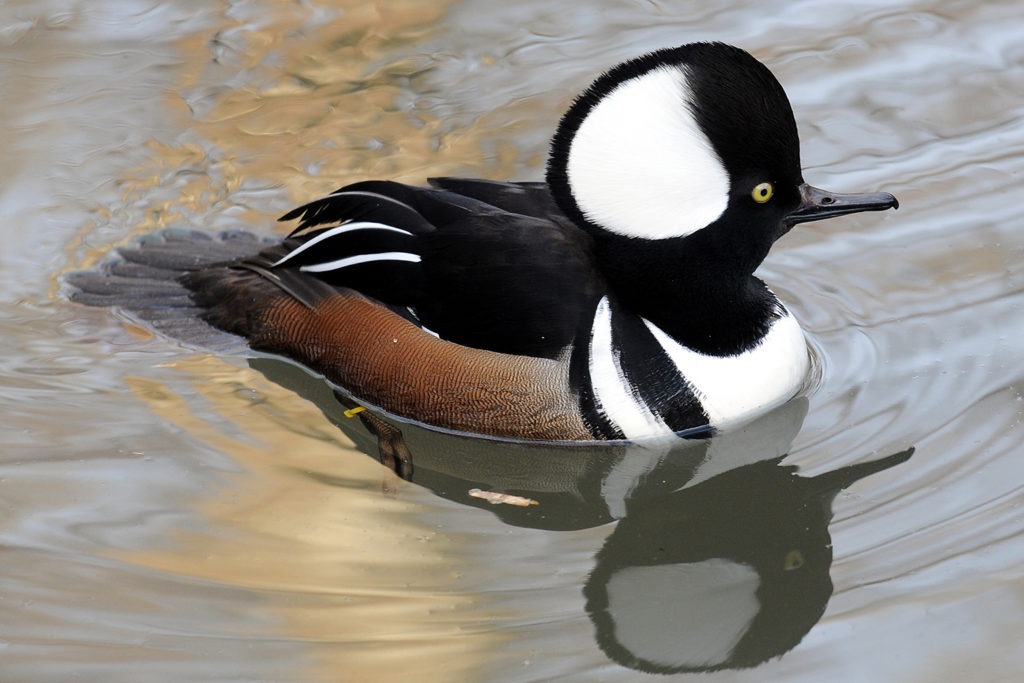
Hooded mergansers have one of the most unusual head shapes of all ducks found in Maryland. Their stunning crests fan out from the back of their heads like a mohawk. Guests can easily tell males apart from females during their breeding season of February to June: males develop striking black and white colorations while females maintain a brownish-gray. Males and females both have the brownish-gray coloration outside of the season.
Who’s Who
Individual ducks in the Marsh Aviary can be specifically identified by the colored bands on their legs, which can be tricky to spot as these diving ducks dip into the water for food. Like most birds in the Maryland Zoo, bands on the left leg indicate the bird is a female, while bands on the right leg indicate the bird is a male.
Where to Find Us
The hooded mergansers in the Marsh Aviary prefer spending most of the day in the water, and don’t have any preferences of what part of the stream they choose to spend their time. Guests may find all of the mergansers together at once, or split up into smaller groups over the day. Generally, if they spot one, at least one more is very close by.
Special Care
The mergansers are exceptional hunters and, at feeding time, they quickly chase tossed fish and bugs through the water. Guests may see them underwater for extended periods of time–up to two minutes–investigating the bottom of the aviary pool for any food left behind.
From time to time, guests may spot a few mergansers walking along the Marsh Aviary boardwalk! While the other ducks will occasionally do this too, the mergansers are the most common boardwalk visitors. Hooded mergansers rest and nest in very high places: in their native habitat, they nest in tree cavities and their ducklings jump out from a significant height just one day after they hatch. It is no surprise, then, that the hooded mergansers at the Zoo prefer to rest high off of the ground in the Marsh Aviary.
Conservation Status
Least Concern
This status means that the population of hooded mergansers living in their native habitat is doing well, but there are always opportunities to ensure this species can thrive.
How you can help
All waterfowl need a safe, clean habitat where they can feed and nest. You can help local Maryland species of ducks, geese, and swans by keeping trash out of wetland habitats and waterways.
You can also support the wellbeing of waterfowl by refraining from giving them human food. Although feeding local wildlife can feel helpful, it can actually harm them. They may become more bold and aggressive. In addition, bread and other human foods are not healthy items for waterfowl.
How the Zoo is helping
The Maryland Zoo is one of many zoos that house animals that have been rehabilitated but can no longer survive without professional care. A bird may be unreleasable due to severe injuries that prohibit movement, a lack of fear of humans, or damage to their senses that makes it hard for them to find food or avoid predators.
Taxonomy
- Kingdom: Animalia
- Phylum: Chordata
- Subphylum: Vertebrata
- Class: Aves
- Order: Anseriformes
- Family: Anatidae
- Genus: Lophodytes
- Species: L. cucullatus