

Overview
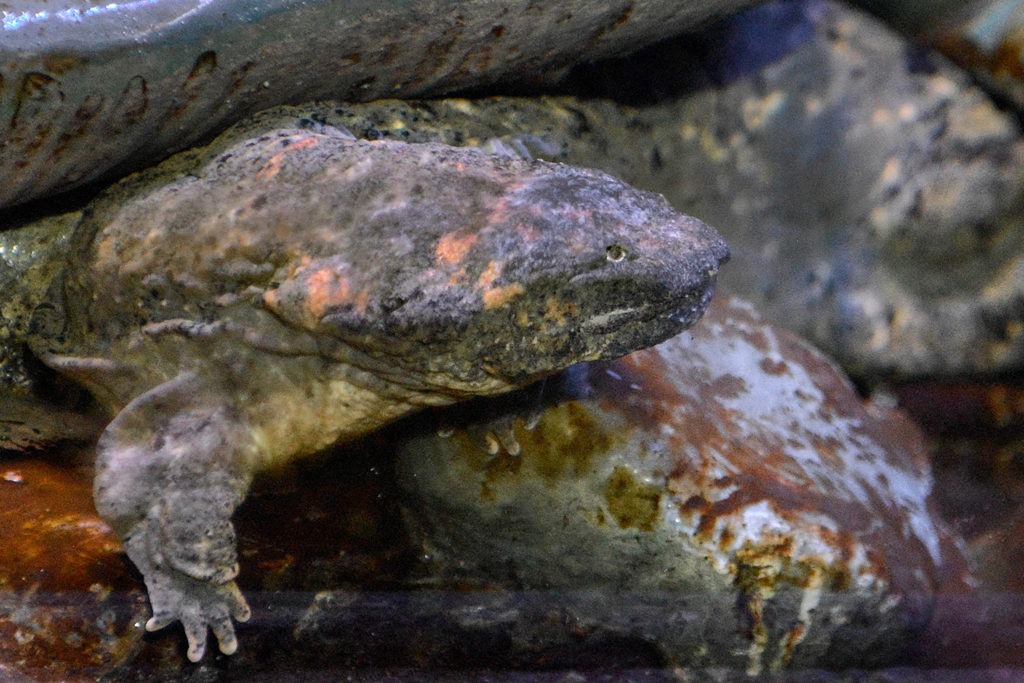
Get to Know Gardulla!
Eastern Hellbenders are one of the rarest animals to find in the state of Maryland. In fact, due to their exceptional camouflage, their nocturnal behavior and their tendency to tuck into tight spaces, they’re incredibly difficult to spot even if you know exactly where to look.
Where to Find Me
There are several species found in the Maryland Wilderness that are well-camouflaged, but Gardulla is certainly the very best at hiding in plain sight. Her gray skin color and massive size matches the flat rocks in her habitat near perfectly, and she naturally spends the majority of the day lying still, waiting for the opportunity to strike at passing prey. To best spot her, look along the thinnest edge of the “rocks” in the habitat– the real rocks end in a straight edge, but the edge of Gardulla’s body is wavy, similar to lasagna. In fact, “lasagna lizard” is one of the names of endearment commonly given to hellbenders, although they are salamanders, not lizards! This wavy skin maximizes the amount of surface area on Gardulla’s body, which in turn maximizes the amount of oxygen that is transferred to her through her skin.
Special Care
Guests may notice that Gardulla is most often spotted on the right side of her habitat. Though it may not look like it, the hellbender habitat water is actually flowing strongly from right to left. Where Gardulla spends her time is often right next to where the water starts its journey after being filtered, which means that it has the highest flow and oxygen content compared to the rest of the habitat. While all areas of the water are perfectly suitable for hellbenders to rest, Gardulla is choosing maximum flow!
Conservation Status
Vulnerable
This status means that the population of Eastern hellbenders living in their native range is facing a high risk of extinction and requires ongoing conservation efforts.
Hellbenders are known as an environmental indicator species, meaning the health of their population in a range is a solid and rapid measure of the health of the environment as a whole. Amphibians quickly respond to sudden changes in their native ranges, especially in the waterways where hellbenders live. Disruption of their habitat through damming, channeling or pollution all directly affect the flow of the water, which directly affects the oxygen and habitat quality for hellbenders. This species, along with most amphibians in Maryland, deeply rely on their environment staying undisturbed.
How you can help
Leave Maryland waterways exactly how you found them! Large flat rocks, known as flagstones, are often used to create dams during nature play, and when the dams are left behind, the environment has been dramatically changed for the animals like hellbenders who are relying on stability. By leaving the flow of the water unchanged, you are keeping a home for many animals stable.
Additionally, remember that every time you enter a new stream, you take a bit of it home with you on the bottom of your shoes. This means that you could potentially be carrying problematic bacteria or fungus that you are bringing with you to every new area you visit, which can cause harm to wildlife. After a day in nature, clear your shoes thoroughly before visiting a new area.
How the Zoo is helping
The Maryland Zoo takes great care to ensure that zoo grounds benefit the wellbeing of all native animals found living within it. The Zoo prioritizes native plants, designs construction with wildlife safety in mind, and routinely surveys the grounds to check on the status of local populations. The zoo also follows very strict biosecurity guidelines, ensuring that harmful bacteria, viruses or fungi do not travel beyond where they were originally picked up.
Taxonomy
- Kingdom: Animalia
- Phylum: Chordata
- Subphylum: Vertebrata
- Class: Amphibia
- Order: Urodela
- Family: Cryptobranchidae
- Genus: Cryptobranchus
- Species: C. alleganiensis