

Overview
Get to Know Daphne and Delilah!
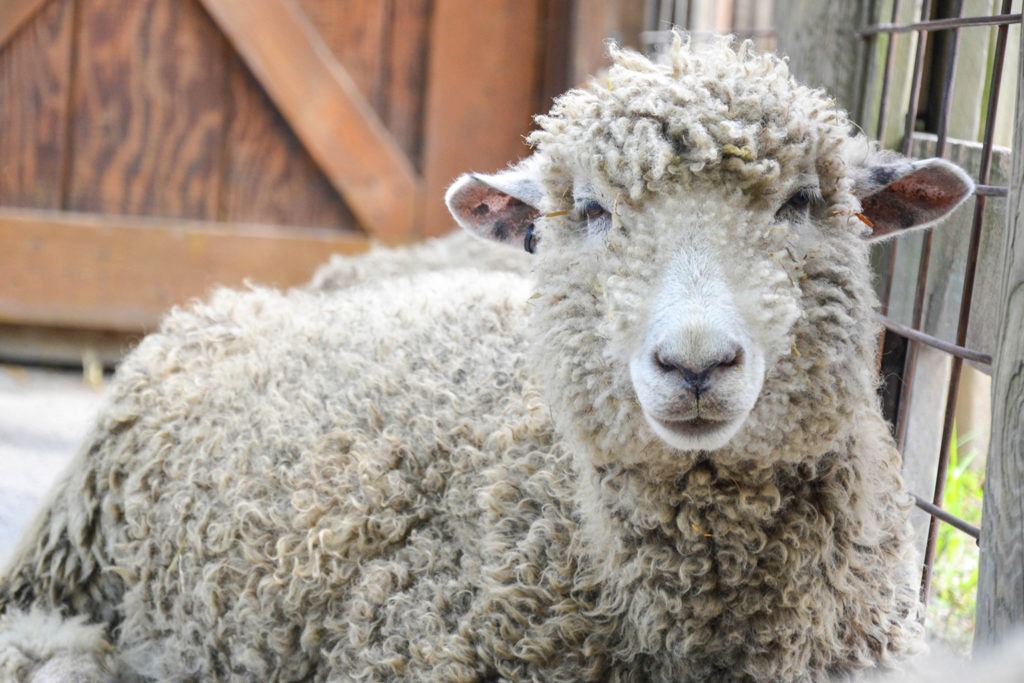
Sisters Daphne and Delilah were born in 2021 and have lived at the Maryland Zoo for most of their lives. They look very much alike, but peer at them closely, and differences become clear. Daphne’s nose has more spots than Delilah’s, and Delilah has a spot on her right ear.
Cotswold sheep are the sheep equivalent of a shaggy dog. They have long, curly wool and a forelock that droops over their eyes–though you might not notice this feature soon after the sheep have been sheared!
Here at the Zoo, the sheep are sheared (have their wool cut) twice each year–in the spring as temperatures rise, and in the fall before the temperatures drop again. Afterwards, animal care staff may give some of the wool to other animals, like the bobcats or leopard, to enjoy as an interesting scent. Additional wool is used to create wool dryer balls, a more environmentally friendly replacement for laundry dryer sheets. These dryer balls are occasionally sold in the Zoo’s Wild Things gift shop.
During a visit to the Zoo’s Farmyard, you are likely to find the sheep interacting with a puzzle feeder for their hay and browse. Much like puzzle feeders for pets, puzzle feeders at the Zoo slow an animal’s eating to a healthy rate. They also give the animals opportunities to solve problems, which is great for their mental wellbeing. The sheep also enjoy interacting with items in their yard that they can headbutt. Headbutting is a natural behavior for sheep, and is part of establishing dominance in a flock.
Conservation Status
Cotswold sheep are a domestic breed, which means that they live closely alongside people. Because they are a domestic breed, they do not have an official conservation status.
Taxonomy
- Kingdom: Animalia
- Phylum: Chordata
- Subphylum: Vertebrata
- Class: Mammalia
- Genus: Ovis
- Species: O. aries
Physical Description
Cotswold sheep are the sheep equivalent of a shaggy dog. They have stocky bodies with long, curly wool and a forelock that droops down over their eyes. The fleece is fine, soft, and white. Their faces are also white, or mottled with tan or grey. They usually have black hooves and occasionally small, black spots on the ears.
Origins
Cotswold sheep were bred originally in the Cotswold Hills of southwest England. They are thought to be descended from the long-wooled sheep that the conquering Romans brought with them to England in the first century A.D.
Introduction to North America
There may have been some unrecorded Cotswold sheep in the United States prior to 1832, but the first ones on record arrived from England that year. To see them at the Maryland Zoo, head to the Farmyard in the Maryland Wilderness.
Uses
Cotswold sheep are raised for cross-breeding purposes, for their fleece, and for the mild flavor of their meat.