
Overview
Get to Know Astrid!
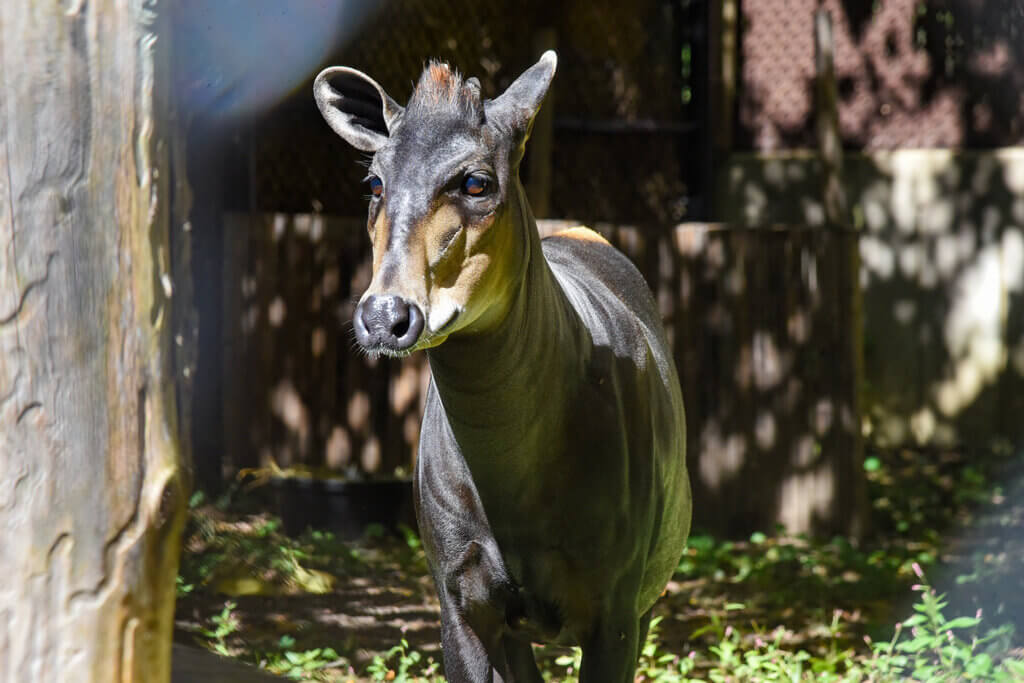
Yellow-backed duikers like Astrid are the largest species of duiker in the world. Most of the 22 species of duiker are known for their low bodies, short horns, and long rear legs, perfect for travelling through dense forest overgrowth. If you’d like to learn about the smallest duiker species in the world, make sure you get to know the blue duikers Flower and Kuruka who also live in the African Journey portion of The Zoo!
Astrid joined us at the Maryland Zoo in June 2026. As is typical for animals new to our Zoo, she spent time at the Zoo’s animal hospital after she arrived to ensure she was in good health prior to moving to her new zoo habitat. Astrid is getting to know her new space, and we will be getting to know her and their routines better in the coming months. Check this page out in the near future to see updates about how Astrid enjoys spending time in her space!
Where to Find Me
Astrid shares a home with Askari the okapi by the Giraffe House in the African Journey. Okapis and yellow-backed duikers are solitary animals, meaning that they typically choose not to be with other members of the same species. However, okapis and yellow-backed duikers are often perfectly content with sharing space with each other within a community of several species. Both okapis and yellow-backed duikers prefer to live in dense forests with plenty of undergrowth, so while Astrid settles into her new space, expect to find her close to trees and shrubs in her yard.
Special Care
Both male and female yellow-backed duikers grow horns which can reach a maximum length of about eight inches. Astrid is unique among yellow-backed duikers because her horns are asymmetrical– one is significantly shorter than the other. This asymmetry could be genetic, or a result of an injury she recovered from earlier in her life. No matter the case, this unique trait does not affect her day-to-day.
Conservation Status
Near Threatened
This status means that the population of yellow-backed duikers living in their native range is facing a significant risk of extinction and requires ongoing conservation efforts. Yellow-backed duiker populations are heavily affected by human activities such as development, logging and mining. While they can tolerate light human activity, large-scale use of the forests they live in can quickly reduce the number of individuals living in that range.
How you can help
In some regions where yellow-backed duikers live, deep underground there are significant sources of coltan, an ore that is used in the production of electronic devices like cell phones. The more we need coltan ore, the more need there is for mining sites to grow that drive yellow-backed duikers away from their homes. You can reduce the need for coltan mining by recycling your devices rather than storing them away. After wiping personal information from your old devices, bring them to the Maryland Zoo and drop them off in designated Eco-Cell recycling points located at the main gate or in Chimpanzee Forest.
How the Zoo is helping
In addition to caring for Astrid at the zoo, the Maryland Zoo partners with Eco-Cell to provide easy opportunities for anyone stopping by the zoo to drop off their electronic devices for recycling. Eco-Cell is one of the Maryland Zoo’s conservation partners among five Signature Animal Programs, which are programs that heavily focus our efforts on species that the zoo has historically had great conservation success with. Eco-Cell is the partner organization for the chimpanzee Signature Animal Program, but supporting the recycling of electronic devices also directly benefits the conservation of other animals living in at-risk areas, like okapi and yellow-backed duikers.
Taxonomy
- Kingdom: Animalia
- Phylum: Chordata
- Subphylum: Vertebrata
- Class: Mammalia
- Order: Artiodactyla
- Family: Bovidae
- Genus: Cephalophus
- Species: C. silvicultor