

Overview
Get to Know Scuttle and Buttercup!
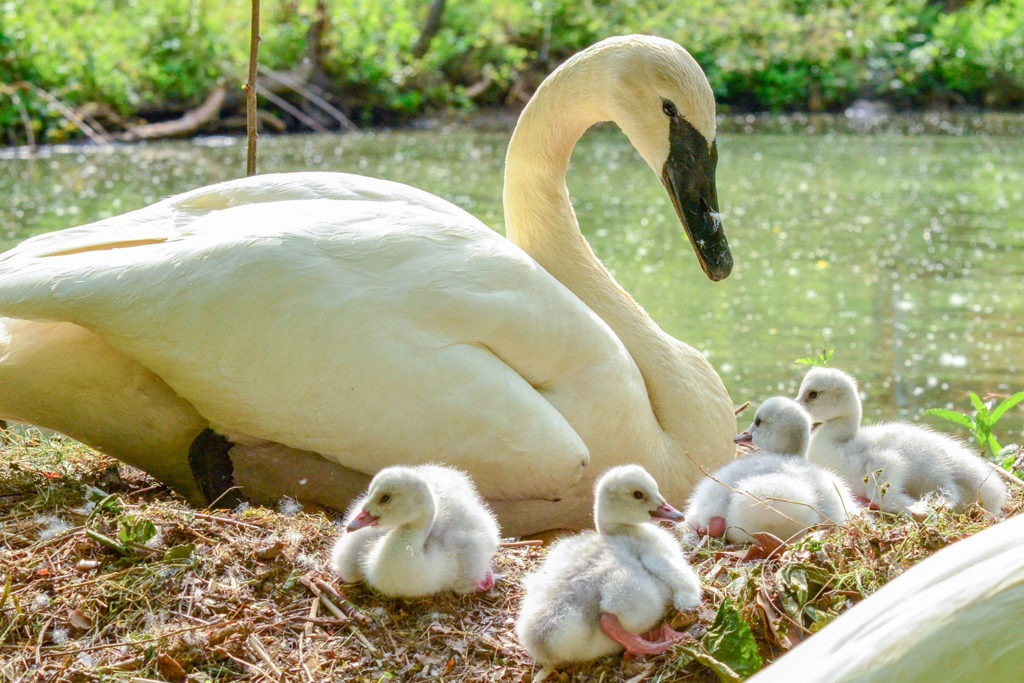
Bonded pair Scuttle and Buttercup have been at the Maryland Zoo for many years. They have been excellent parents, raising numerous clutches in their large nest in the Zoo’s Farmyard. Some of their chicks have moved on to other zoos. Others have been sent to Iowa and to Oregon to be released to trumpeter swan native range. These releases are part of a partnership with the Departments of Natural Resources in those states.
Lucky Zoo guests may get to hear the trumpeter swans make the call that gives this animal its name. Trumpeter swans call with a sound much like short blasts of a bugle. Trumpetering back and forth, the swans call to sound an alarm, to defend their territory, and to keep the family together.
Want to impress your friends? Know your swan vocabulary! A male swan is called a cob, a female is a pen, and a baby swan is a cygnet.
Conservation Status
Least Concern
This status means that the population of trumpeter swans living in their native range is doing well. But that has not always been the case. Trumpeter swans once lived across North America from the Pacific to the Atlantic. When European settlers arrived in North America, they hunted the swans to near extinction.
Through conservation efforts to protect the birds, the number of trumpeter swans has begun to grow again. However, we still need to be mindful of how human actions like draining wetlands for roads and buildings, affect wildlife and their homes. Today, trumpeter swans continue to lose habitat from ongoing destruction and degradation of wetlands.
Taxonomy
- Kingdom: Animalia
- Phylum: Chordata
- Subphylum: Vertebrata
- Class: Aves
- Order: Anseriformes
- Family: Anatidae
- Genus: Cygnus
- Species: C. buccinator
“Where I live”
Trumpeter swans once nested across most of North America but are now found only in isolated areas of the northwest and north-central regions of the continent. They are native to both the United States and Canada. Biologists currently recognize three distinct populations: the Pacific Coast population, the Rocky Mountain population, and the Interior population.
“How I live there”
Trumpeter swans are long-lived, social birds that thrive in quiet areas of open water free from human disturbance. They inhabit lakes, ponds, rivers, and coastal bays and seek out tidal mudflats during the winter. They are well adapted to the sometimes harsh environments in which they live. An extremely dense layer of down makes them very tolerant of cold conditions.
Active during the day, trumpeter swans feed mainly on aquatic plants. They forage on land as well during the winter. For the first few weeks of life, cygnets (swan chicks) feed primarily on insects and other invertebrates but then transition to a plant-based diet.
Trumpeter swans put their long necks and strong feet to good use uprooting aquatic plants growing in water up to four feet deep. By pumping their back feet, the birds create a current that helps dislodge plant roots from surrounding mud. By dipping their necks well below water, they can get a good grip on plants and dislodge them.
“Making my mark”
Trumpeter swans are large and majestic birds with white feathers, black bills, and long, straight necks. They are sometimes mistaken for tundra swans, another species native to North America. Trumpeter swans are much larger, though, and can be identified by their deep, resonant, trumpet-like call.
Want to impress your friends? Know your swan vocabulary! A male swan is called a cob, a female is a pen, and a baby swan is a cygnet.
Raising Young
Trumpeter swans form pair bonds when they are 3 or 4 years old and typically stay with the same mate for life. They arrive at their breeding grounds together, often before ice has fully melted. Pairs engage in courtship behaviors for several days before choosing a site for nest building. Most pairs will return to their previous nest site if possible and simply repair and add to last year’s nest.
Trumpeter swans tend to nest in freshwater marshes and other shallow wetlands where they can find plenty of nesting material and cover, as well as a rich supply of food. They build massive nests from aquatic vegetation, grasses, and sedges. Males gather the nesting materials and females do the building, often atop an elevated site that is surrounded by water such as a beaver lodge or small island. Each nest is a large mound with a depression in the center, lined with feathers and down. A typical nest can measure up to five feet across and weigh hundreds of pounds!
A female trumpeter swan lays 4 to 6 eggs and incubates them for approximately 32 days until the cygnets hatch out. She will leave the nest only occasionally to feed, bathe, and preen her feathers. During incubation, the male guards the nest from predators. Within 24 hours of hatching, cygnets are able to swim and feed themselves. Parents stay close and lead them to good feeding areas.
Interestingly, female trumpeter swans begin to moult at about the time that their chicks hatch out. Females remain flightless for approximately one month, during which time they tend to their chicks. Just as they get their new flight feathers, males begin to moult. Staggered moult cycles insure that at least one parent remains “grounded” with the chicks until they fledge, which occurs about two months after hatching.
“What eats me”
Adult trumpeter swans have few natural predators but there are many animals that will seize eggs and chicks, including eagles, owls, coyotes, mink, otters, and ravens.